What a phone can actually measure in your serve
Most serve-analysis apps give you a category name and a percentage and let you assume the camera saw everything. It didn’t. Here is FormCourt’s whole serve rubric, in public: 11 measured checkpoints with the target ranges they are graded against, 5 estimated ones deliberately excluded from your score, and 5 that a camera will never see, marked as such instead of faked.
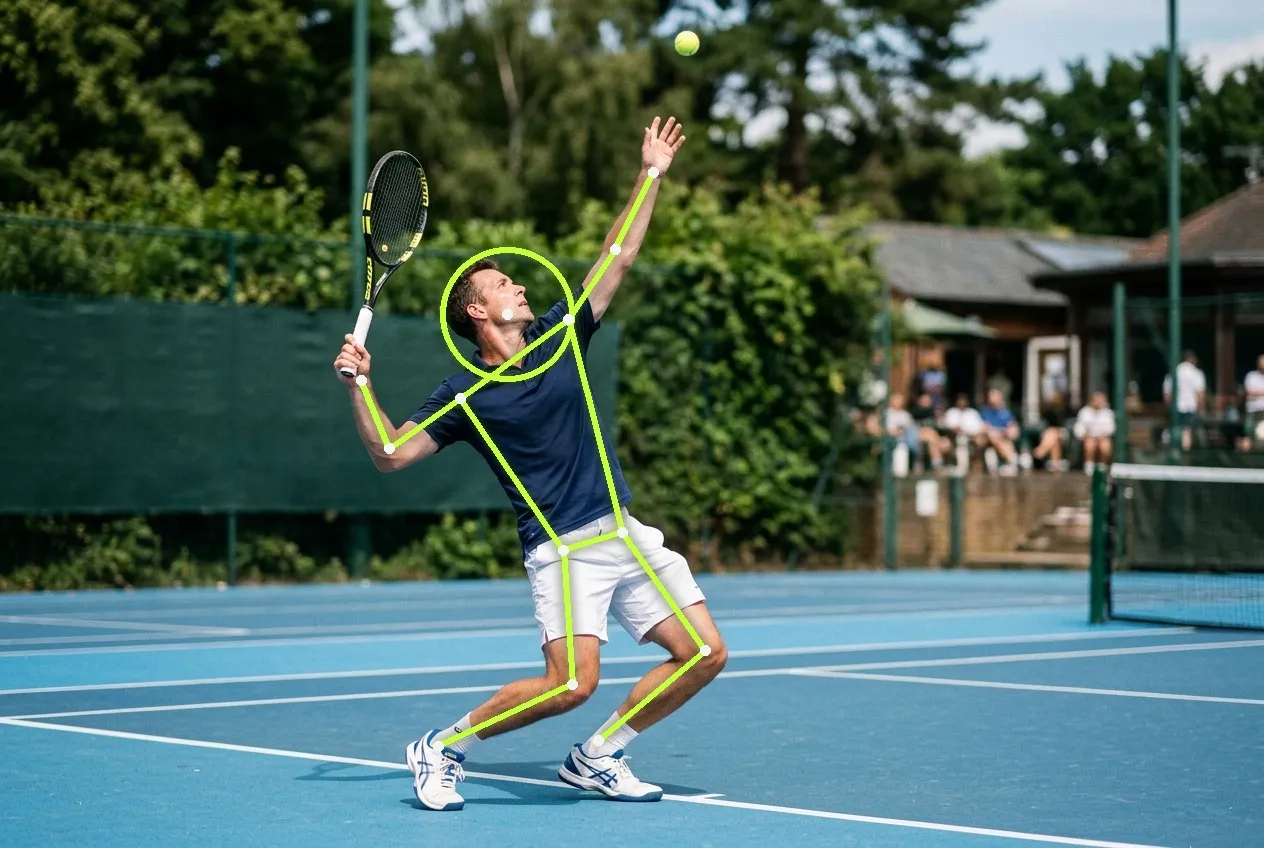
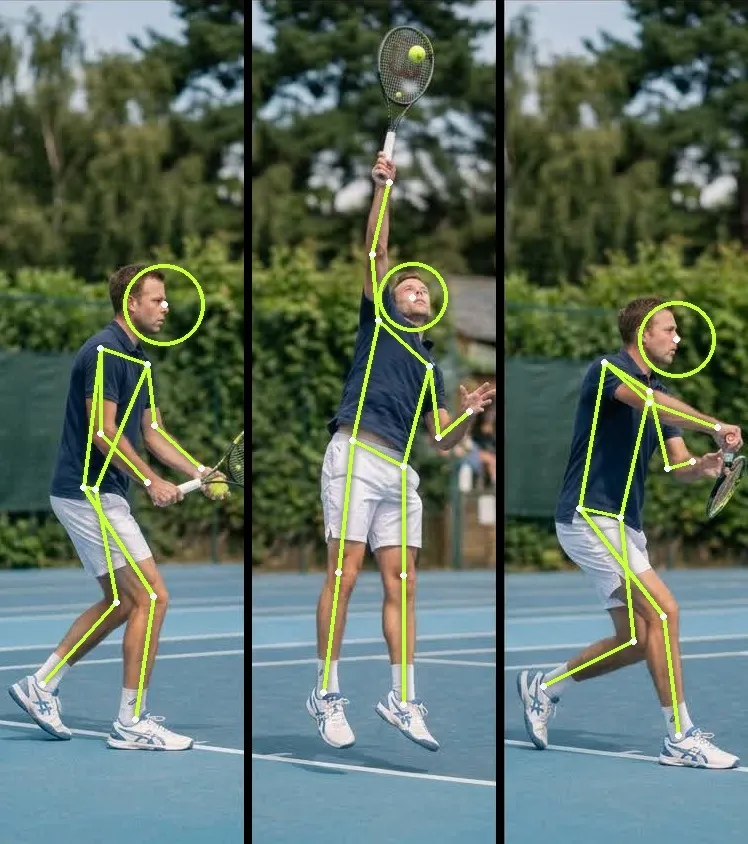
Grip & Setup
NOT SCOREDGrip Check
CHECKLISTNot visible to the camera — confirm it yourself once in setup.
Continental grip: index base knuckle on bevel 2, held for every serve type. It is what makes pronation happen on its own.
Stance Setup
CHECKLISTFoot angle and stance width are out of a side-view camera's plane — not graded.
Balanced base, feet about shoulder-width, front foot angled toward the right net post. Platform or pinpoint is your choice, not a fault.
Toss & Loading
SCORED CATEGORYWeight Shift
Hip midpoint travel before trophy: back, then forward, scaled to your torso.
TARGETclear back-then-forward rock
Weight rocks back onto the rear foot, then forward onto the front foot as both arms lift. Direction and smoothness matter; how far is individual.
Toss Release
Tossing-arm elbow angle across the lift (20th percentile).
TARGET≥ 165° straight
Tossing arm stays near-straight through the lift, driven from the shoulder; the ball rolls off the fingertips while the arm is still rising. Release height is coach preference, not a standard.
Toss Height
The tossed ball's flight, fitted to the detections and checked against gravity: its apex above the height the same flight had at contact, scaled to your torso. Needs the ball in frame during the toss.
TARGETapex 70–140 % of torso above contact
The ball peaks just above the contact point and is struck on its way down — a toss far above contact adds timing error, a toss below it forces a cramped, rushed swing.
Knee Bend
Interior knee angle at the trophy frame.
TARGET100–125° (≈ 65° flexion, elite mean)
Deep knee flexion loaded during the toss — the legs are the first link of the power chain. Wide individual range.
Toss Placement
EST.Ball position at contact relative to your front foot when the ball is detected (graded); otherwise estimated from the hitting wrist.
Flat/slice: forward into the court on the hitting side. Kick: further back toward 11–12 o'clock. A toss squarely over the head raises arm abduction and, with it, subacromial impingement risk (Kovacs and Ellenbecker, Sports Health 2011).
Body Coil
EST.Estimated from shoulder-width foreshortening between toss and trophy; a side view can't measure the angle.
Trunk and hips coil away from the net during the load. Magnitude is individual.
Trophy Position
SCORED CATEGORYElbow Position
Elbow height vs shoulder line at trophy, plus elbow angle.
TARGETelbow level with shoulders · 90–105°
Hitting elbow at or near the shoulder line, forming the V, flexed roughly 90–105°. Judged relative to the shoulder line — an abbreviated takeback is not a fault.
Tossing Arm
Tossing-arm elbow angle and wrist height at trophy.
TARGET≥ 160° · wrist above shoulder
Tossing arm near-straight and still up, pointing at the ball — not dropped early, not required to be vertical.
Racquet Face
CHECKLISTNo racquet detection — checklist only.
Racquet on edge toward the side fence at trophy, not open to the sky ("waiter's tray").
Racquet Drop & Chain
SCORED CATEGORYLeg Drive
Hip rise from trophy to contact, scaled to your torso, plus forward travel.
TARGETclear upward drive
Drive up and forward into the court from the loaded legs. Platform vs pinpoint does not change ball speed.
Shoulder Tilt
Shoulder-line tilt from horizontal between trophy and contact (85th percentile).
TARGET≥ 35°
Back shoulder drives up and over the front shoulder — a cartwheel, not a flat spin. The tossing arm folds toward the torso as the trunk rotates.
Racquet Drop
EST.Racquet head at its lowest below the hitting shoulder before contact, from the racquet detector (graded); otherwise estimated from the wrist.
Racquet drops behind the back, below shoulder-blade height, as a consequence of a relaxed arm and shoulder rotation — not a deliberate pull-down.
Contact & Finish
SCORED CATEGORYContact Reach
Elbow angle at contact and wrist height over your standing span.
TARGET20–30° flexion · ≈ 1.6× span
Contact near full reach with 20–30° of elbow flexion left, taken on the ball's way down from its peak — not at the apex, and not with a locked arm.
Head Up
Ear-to-nose angle above horizontal at contact.
TARGET≈ 32° head extension (elite)
Head and eyes stay up in the contact zone through impact. Pulling the head down early drops the shoulder and the contact point.
Soft Landing
Front-knee flexion in the 300 ms after landing.
TARGET≥ 15° flex
Absorb the landing with a soft knee flex. Peak landing force is roughly 2.3–2.8× body weight (Frontiers in Physiology, 2023) — the camera can't measure force, only the knee.
Front-Foot Land
EST.Which heel returns to the ground first (BlazePose feet when available, else the ankles). A side view can mix up left and right, so this stays a label.
Land balanced on the front foot with the body travelling forward into the court. Depth inside the baseline is an outcome, not a target.
Follow Through
EST.Estimated from whether the hitting wrist passes below the hips after contact.
Racquet decelerates down and across the body toward the non-dominant hip. The follow-through is the serve's most violent phase, so cutting it short is both a power leak and a shoulder risk (Kovacs and Ellenbecker, Sports Health 2011).
Pronation
CHECKLISTForearm rotation is invisible to a 2D pose camera — explainer only.
Forearm rotation at impact is a consequence of the continental grip, not a separate action to add.
Back Leg Kick
CHECKLISTObserved, not graded — no published target.
The back leg swings back and up as a counterbalance so the landing is on the front foot. Timing and amount vary widely.
Why publish this
An honest gap beats a confident guess.
A table like this is easy to leave out, because “20+ parameters analysed” sells better than a real count with the misses in it. But the moment you feel one number is invented, every other number in the app becomes worthless too. FormCourt would rather tell you the frame was bad.
Shoulder tilt is the checkpoint most club serves fail, and it is the one you cannot feel: from inside the motion, tilting and spinning are the same sensation.
FAQ
Serve analysis questions
What is a good tennis serve score?
FormCourt grades each measured checkpoint on a bell curve where the centre is the elite band, so 100 is not "perfect" — it is "indistinguishable from a tour serve on this measurement." A club player hitting a clean, repeatable serve should land in the 60s and 70s on those bands — that follows from where the bands are centred, not from a measured population. What matters is the shape: which two checkpoints sit twenty points below the rest.
Why is my serve marked PARTIAL?
Because the camera did not get enough of it. A stroke is partial when one of its scored categories has no grade at all, or when too few of its measured checkpoints came through. Usually that means the framing cut off your reach, the ball was never visible during the toss, or the light was too low for clean joint tracking. Partial serves still show you everything that was measured — they just do not pretend the total is comparable.
Can a phone camera measure shoulder rotation?
Not the true angle, no. From side-on, a rotation toward or away from the lens is foreshortening, not displacement. That is why body coil is listed as estimated and kept out of the score, while shoulder tilt — which happens in the camera plane — is measured and graded. Any app that hands you a confident hip-rotation percentage from one side-on 2D video is inferring it, whether or not it says so.
What camera angle should I film a serve from?
Side-on, at roughly hip height, far enough back that your full body and the top of your racquet reach both stay in frame through the whole motion. Landscape is fine. Sixty frames per second is better than thirty because contact lasts about four milliseconds, but thirty works.
Where do the target ranges come from?
Published serve-kinematics literature — including a 2024 meta-analysis of 27 studies — cross-read against USTA coaching checkpoints. Where the research shows a wide individual range rather than a target, FormCourt says so instead of inventing one. Knee bend is a good example: the elite mean is about 65° of flexion, and the spread around it is enormous.
On iPhone
Measure it, then fix it.
Your lowest checkpoints become next week’s drills. That is the whole product.
iPhone · iOS 17 or later · free to install · three analyses a month free