What a phone can actually measure in your forehand
Forehands get coached in adjectives: more topspin, more lag, get it out in front. Here is what a camera can put a number on. Here is FormCourt’s whole forehand rubric, in public: 10 measured checkpoints with the target ranges they are graded against, 6 estimated ones deliberately excluded from your score, and 2 that a camera will never see, marked as such instead of faked.
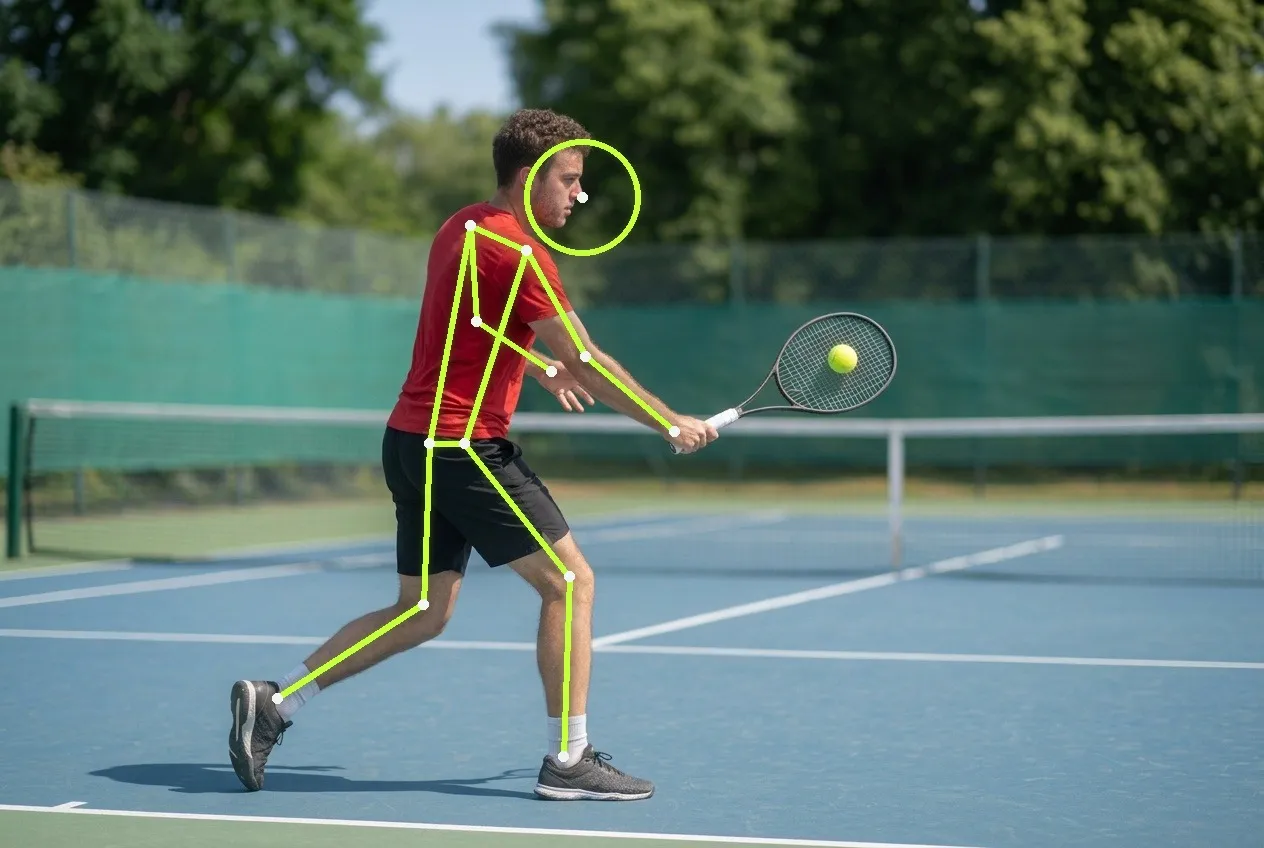
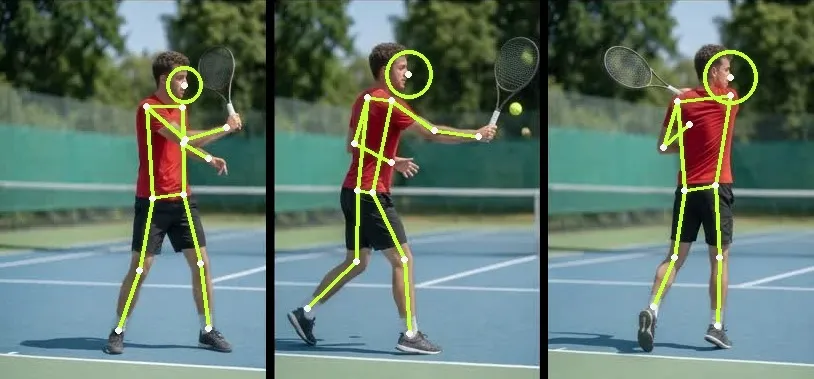
Setup & Turn
SCORED CATEGORYNon-Dominant Arm
Off-arm elbow angle at turn-complete.
TARGET≥ 150° extended
The off arm extends across the body toward the ball, locking the shoulder turn in and setting the spacing.
Ready Position
EST.Knee angle and hands together at the start of the swing window.
Knees flexed, weight on the balls of the feet, both hands on the racquet in front of the chest before the turn.
Unit Turn
EST.Shoulder-line foreshortening between the ready frame and turn-complete — estimated at this camera angle.
Shoulders, torso and racquet turn together as one unit, about 90°, as soon as the ball is read.
Stance
EST.Front-foot offset along the swing direction, from the heels (BlazePose) or ankles — a label, not a score.
Open or semi-open for pace and wide balls, neutral to step into short balls. Pros hit 70–85 % open. A choice, never a fault.
Grip
CHECKLISTHand orientation is invisible to the camera — confirm once in setup.
Eastern or semi-western (bevel 3 or 4): topspin without losing drive through the court. Grip sets your natural contact height.
Load & Lag
SCORED CATEGORYLeg Load
Smallest knee angle from turn-complete to the racquet drop.
TARGET95–120° included
Load the outside leg during the turn — the legs start the chain. About 70° of flexion open, 80° neutral (elite).
Takeback
Hitting-wrist height vs the shoulder line at turn-complete, scaled to your torso.
TARGETwrist 0–40 % of torso below the shoulders
Compact loop: wrist just below shoulder height, elbow away from the ribs, racquet head above the hand.
Racquet Lag
Racquet head below the hitting wrist at the drop, from the racquet detector.
TARGEThead ≥ 20 % of torso below the wrist
As the hips start forward the racquet head drops below the hand ("pat the dog") and trails the wrist — a relaxed arm, not a pull.
Hips Before Shoulders
Order of the speed peaks of hip, shoulder, elbow and wrist into contact. Needs 60 fps (recorded clips).
TARGEThip → shoulder → elbow → wrist
Rotation starts from the ground: hips, then trunk, then arm, racquet last. Elite peaks run hip −97 ms → shoulder −45 → wrist −37 → racquet −2 ms before impact.
Contact
SCORED CATEGORYContact Height
Ball (or racquet head, or wrist) height vs the hips at contact.
TARGEThip level to 50 % of torso above
Waist to chest, set by your grip: eastern near hip height, semi-western above it.
Contact Spacing
Elbow angle at contact; the hitting arm lies in the image plane at this angle, so this is exact.
TARGET100–180° · style shown as a label
Elbow neither pinned to the ribs nor locked. Double-bend and straight-arm are both legitimate; comfort and consistency matter.
Head Still
Nose travel from 100 ms before to 200 ms after contact, scaled to your torso.
TARGET≤ 12 % of torso
Head fixed on the contact zone through impact. Only 10 of the ATP top-100 show total fixation — it is rare and it is a skill.
Low-to-High Path
Racquet-head path angle over the last frames into contact (horizontal corrected for the 45° camera).
TARGET20–45°
The racquet brushes up the back of the ball: ≈ 20° for flat, 30–40° for topspin.
Contact In Front
EST.Ball / racquet head ahead of the front hip along the swing — forward and lateral offsets are summed at 45°, so estimated.
Contact comfortably in front of the front hip. Late contact opens the face and loses pace.
Finish
SCORED CATEGORYFollow Through
Racquet head (or wrist) height vs the opposite shoulder when the swing settles, and whether it crossed the body.
TARGETacross the body, at or above the opposite shoulder
A full finish across the body, over the opposite shoulder or around the waist (wiper). Stopping at the ball is a power leak: the racquet decelerates into contact instead of through it.
Non-Dominant Catch
EST.Off wrist near the racquet head at the finish — often hidden from behind.
The off hand meets the racquet near the opposite shoulder — a sign of full rotation.
Spin
EST.Estimated from the path angle and finish height. Racquet face angle needs racquet keypoints (later).
Topspin from a steep low-to-high path and a high finish; flat from a flatter path; slice from high-to-low.
Wiper Pronation
CHECKLISTForearm rotation is invisible to the camera.
The forearm rolls over after contact as a consequence of grip and path — nothing to add on purpose.
Why publish this
An honest gap beats a confident guess.
A table like this is easy to leave out, because “20+ parameters analysed” sells better than a real count with the misses in it. But the moment you feel one number is invented, every other number in the app becomes worthless too. FormCourt would rather tell you the frame was bad.
The order your body segments fire in — hips, then shoulders, then elbow, then wrist — is invisible from inside the swing and is the single biggest separator between a 3.5 forehand and a 4.5 one.
FAQ
Forehand analysis questions
What does FormCourt actually measure in a forehand?
Ten checkpoints across four scored categories: the turn (off-arm extension), the load (leg load, takeback height, racquet lag, and the order your hips, shoulders, elbow and wrist fire in), contact (height against your hips, elbow angle, head stillness, and the low-to-high path angle) and the finish. Six more — ready position, unit turn, stance, contact in front, the off-hand catch, spin — are estimated at this camera angle and stay out of the score.
What is “hips before shoulders” and why does it need 60 fps?
It is the kinetic-chain order: your hips should reach peak rotational speed first, then the shoulders, then the elbow, then the wrist. Each link accelerates the next lighter one. Getting the order wrong is the most common reason a strong player has a weak forehand. Measuring it means finding four speed peaks that can sit 30–60 ms apart, which is one or two frames at 30 fps and three or four at 60 — so FormCourt grades it on recorded 60 fps clips and skips it otherwise rather than guessing.
Do I have to film the forehand from the side too?
A three-quarter angle — roughly 45° behind and to the side — is better for groundstrokes, and the rubric is calibrated for it. Anything the angle compromises is marked estimated: contact-in-front and the unit turn both get labels instead of grades, because at 45° forward and lateral offsets are mixed together.
Does it grade topspin?
It estimates it, and says so. Spin is inferred from the low-to-high path angle and the finish height, both of which are real measurements, but the racquet face angle at impact is what actually determines spin and that needs racquet keypoints the detector does not produce yet. So spin is a label, not a number in your score.
Can it tell an inside-out forehand from a crosscourt one?
No, and it will not pretend to. FormCourt grades the mechanics that produced the shot, not where the ball went. Court-relative ball work — depth, placement, in or out — is deliberately outside the product.
On iPhone
Measure it, then fix it.
Your lowest checkpoints become next week’s drills. That is the whole product.
iPhone · iOS 17 or later · free to install · three analyses a month free